
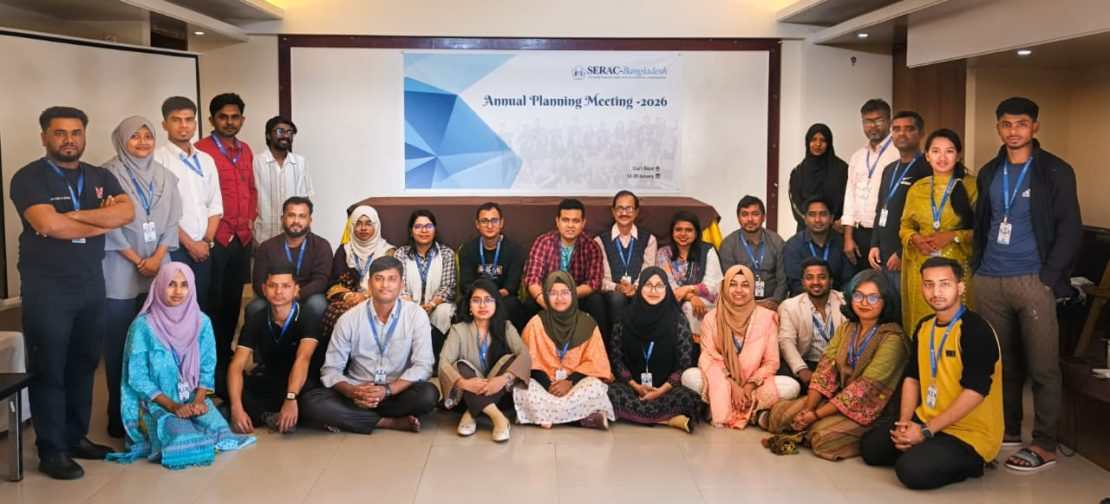
From January 18 to 20, SERAC-Bangladesh successfully hosted its Capacity Building and Annual Planning Meeting 2026 in the scenic setting of Cox’s Bazar. The three-day gathering brought together dedicated staff members from diverse programs, creating a dynamic space for learning, reflection, collaboration, and strategic planning for the year ahead. The event was jointly organized under two key initiatives of SERAC-Bangladesh- SHIFT: Strengthening, Harnessing, and Integrating Fair Transitions through Urban Youth Councils in Bangladesh and STRIDE: Strengthening Institutional Resilience, Development & Engagement, highlighting a collaborative approach to strengthening organizational capacity and institutional resilience.
Setting the Foundation
The meeting began with a Ground Setting and Program Orientation session led by Deputy Director Md. Salim Miah, who emphasized professionalism, workshop guidelines, and the importance of active participation. This session set a positive and focused tone for the entire event, reinforcing SERAC’s commitment to discipline, collaboration, and shared responsibility.

Fostering a Positive Organizational Culture
In an engaging and interactive session, Executive Director S M Shaikat facilitated discussions on Office Etiquette, highlighting workplace ethics, integrity, and mutual respect. The session encouraged open dialogue and reflection, reinforcing the importance of cultivating a respectful and inclusive organizational culture where every team member feels valued.
Commitment to Safeguarding and Accountability
A central highlight of the meeting was the session on Safeguarding Principles and Official Roles & Responsibilities, jointly led by Deputy Director (Finance and Admin) Md. Emran Hossain and Project Director Shahina Yasmin. This session reaffirmed SERAC-Bangladesh’s unwavering commitment to protection, inclusion, and accountability- ensuring safe, ethical, and responsible programming for staff, volunteers, and the communities served.
 Enhancing Productivity and Organizational Efficiency
Project Manager Lutfa Pathan facilitated an interactive session on Personal Productivity and Time Mastery, featuring a comprehensive presentation on time management. The session addressed common time management challenges, emphasized the importance of effective time utilization, and introduced the three-step approach to identifying priorities. Participants explored practical planning techniques such as to-do lists, calendar scheduling, and time blocking, alongside strategies for managing distractions, conducting regular evaluations, and making necessary adjustments. The session concluded with hands-on orientation to Google Workspace tools, including Google Tasks Management and Google Calendar, enabling participants to apply these tools effectively in fast-paced professional environments.
Essential HR and administrative procedures were also covered by Finance and Admin Officer Rabeya Akter Munmun, providing clarity on internal processes and reinforcing transparency and compliance across the organization.
 Looking Ahead: Communication and Sustainability
The meeting concluded with a forward-looking and thought-provoking session led by Executive Director S. M. Shaikat on Effective Communication and Sustainability Models, setting a clear direction for SERAC-Bangladesh’s growth in 2026 and beyond.
The Effective Communication segment equipped staff with practical strategies to strengthen both internal and external communication. Through interactive discussion, participants explored the 7C’s Framework of Communication, the role of communication in leadership, and why effective communication is essential for teamwork, accountability, and impact. The session also highlighted key communication skills for leaders, communication beyond words, common communication mistakes, and ways to create a culture of openness and trust within the organization. These insights significantly enhanced participants’ communication capacity and confidence in professional engagement.
The session concluded with a collaborative and action-oriented segment on Sustainability Models, where participants worked in teams to identify practical and innovative approaches to ensure SERAC-Bangladesh’s long-term impact. Teams explored ideas related to program sustainability, resource optimization, community ownership, partnership development, and organizational resilience. This hands-on exercise encouraged collective thinking and ownership, generating realistic pathways for embedding sustainability into programs, operations, and future strategic planning.
 Together, the sessions reinforced SERAC-Bangladesh’s commitment to effective communication, sustainable growth, and long-term impact, empowering staff to translate shared vision into meaningful action.