
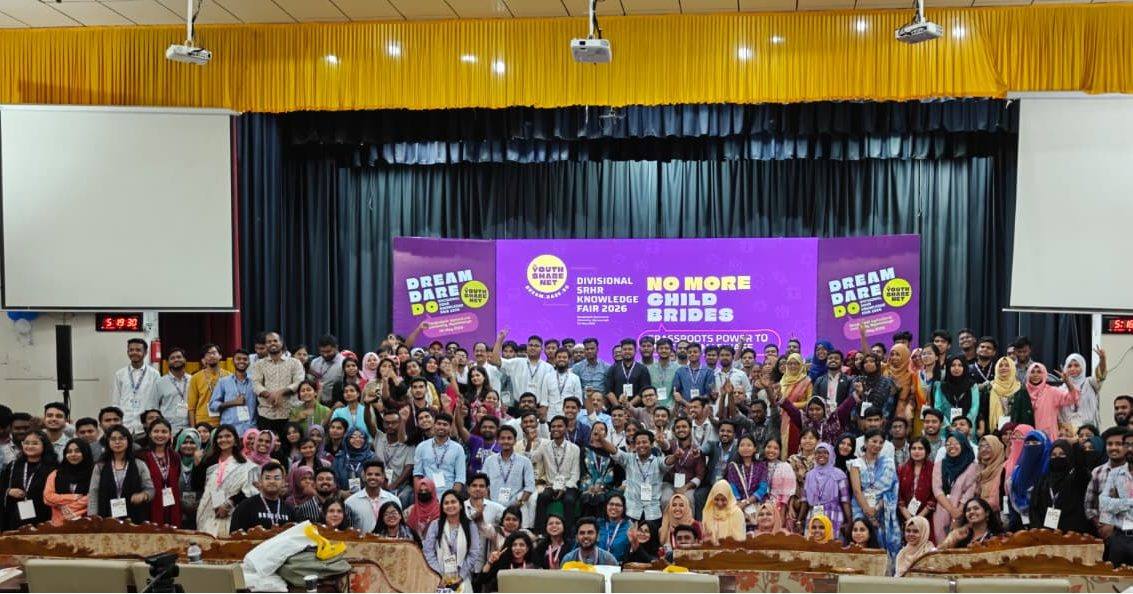
 On 4 May 2026, the Divisional SRHR Knowledge Fair 2026 was successfully held at Bangladesh Agricultural University under the theme of preventing child marriage and strengthening community-led action for adolescent health and rights. Organized by SERAC-Bangladesh together with RedOrange under the Youth Share-Net (YSN) Project, and supported by AmplifyChange, the event brought together around 300 participants including government officials, youth leaders, SRHR practitioners, development professionals, community representatives, students and media personnel from across the Mymensingh division.
The Knowledge Fair was organized as part of a broader effort to connect grassroots realities with national policy dialogue on Sexual and Reproductive Health and Rights (SRHR). This year’s divisional knowledge fair focused specifically on child marriage, one of the most persistent human rights and public health challenges affecting adolescent girls in Bangladesh. Bangladesh still has the highest child marriage rate in Asia, with 51.4 percent of women aged 20–24 married before the age of 18.
 The event began with an Opening Plenary titled “From Commitment to Community: Bridging Policy and Reality in Preventing Child Marriage.” The session was chaired by Arnob Chakrabarty, Managing Director of RedOrange and distinguished guests including Ummey Habiba Mira, Deputy District Commissioner as the Chief Guest and Md. Motiur Rahman as the Special Guest. The opening address was delivered by SM Shaikat, Executive Director of SERAC-Bangladesh. A child marriage survivor’s story highlighted the lived realities of adolescent girls affected by child marriage and emphasized the urgent need for community-based prevention strategies.
Throughout the day, the Knowledge Fair hosted a series of thematic discussions, youth dialogues, research presentations, and cross-sectoral conversations focusing on the root causes and consequences of child marriage. These sessions explored the intersections between poverty, gender inequality, climate vulnerability, limited access to SRHR services and social norms that continue to sustain child marriage in rural communities.
 The first thematic session, “Youth Realising Dreams: Aspirations vs Action For Better Future,” focused on youth aspirations, leadership and barriers faced by adolescents in achieving safer and more empowered futures. The session was chaired by Jannatul Munia, Director-Strategy, RedOrange including a research presentation by Md. Nazmul Hasan, Project Manager of SERASC-Bangladesh alongside youth panellists from different organizations and platforms.
The second session, “Sharing Ideas – Dare to Prevent Challenges: Transforming Social and Gendered Realities,” brought together civil society leaders, journalists, and social activists to discuss multi-sectoral responses to SRHR challenges and child marriage prevention. The session was chaired by Khaleda Yasmin, Director, Health, RedOrange and panellists including M A Kaiyum, Secretary General of Mymensingh Press Club, Suborna Poli Drong, Executive Director, Shanti Mitra and Advocate Foysal Ahmed, Social Activist.
In the afternoon, the third session titled “Networking For Action: Strengthening Systems and Community Responses” focused on coordinated government action and institutional responses to SRHR and child marriage. The session was chaired by Md. Mazharul Hoque Chowdhury, DD-DGFP, Mymensingh District in a panel discussion with key government representatives from across the division. The keynote presentation was delivered by Professor Dr Md. Bakhtiar Uddin, who emphasised the importance of integrating education, economic empowerment, and youth participation into efforts to prevent child marriage.
 One of the major outcomes of the event was the development of the “Mymensingh Recommendation on Child Marriage” a divisional declaration incorporating grassroots evidence, youth perspectives, and community recommendations. The declaration will be presented at the National SRHR Knowledge Fair 2026 to contribute to national-level advocacy and policy dialogue.
The closing session, “Voices to Action: Shaping the Mymensingh Recommendation on Child Marriage” was chaired by SM Shaikat, Executive Director of SERAC-Bangladesh. The session featured special guests Dr. Pradip Kumar Saha, Director (Health), Md. Harun Or Rashid, DD- Youth Development, Mymensingh and Md. Suzan Ahmed Chowdhury, DD- Islamic Foundation, Mymensingh
Beyond formal discussions, the event also featured participatory exhibitions, youth networking opportunities, and cultural performances centred on SRHR, gender equality, and social empowerment. Youth leaders, community organizations and practitioners showcased local initiatives aimed at preventing child marriage and supporting adolescent girls at risk.
The Divisional SRHR Knowledge Fair 2026 demonstrated that preventing child marriage requires more than policy commitments alone. It requires listening to grassroots communities, empowering adolescent girls, strengthening local accountability systems, and ensuring coordinated action across sectors.
 By bringing together policymakers, young people, civil society organizations and frontline actors on a single platform, the event reinforced an important message: ending child marriage in Bangladesh is not only a legal responsibility, but also a collective social commitment toward dignity, education, equality, and justice for every adolescent girl.