
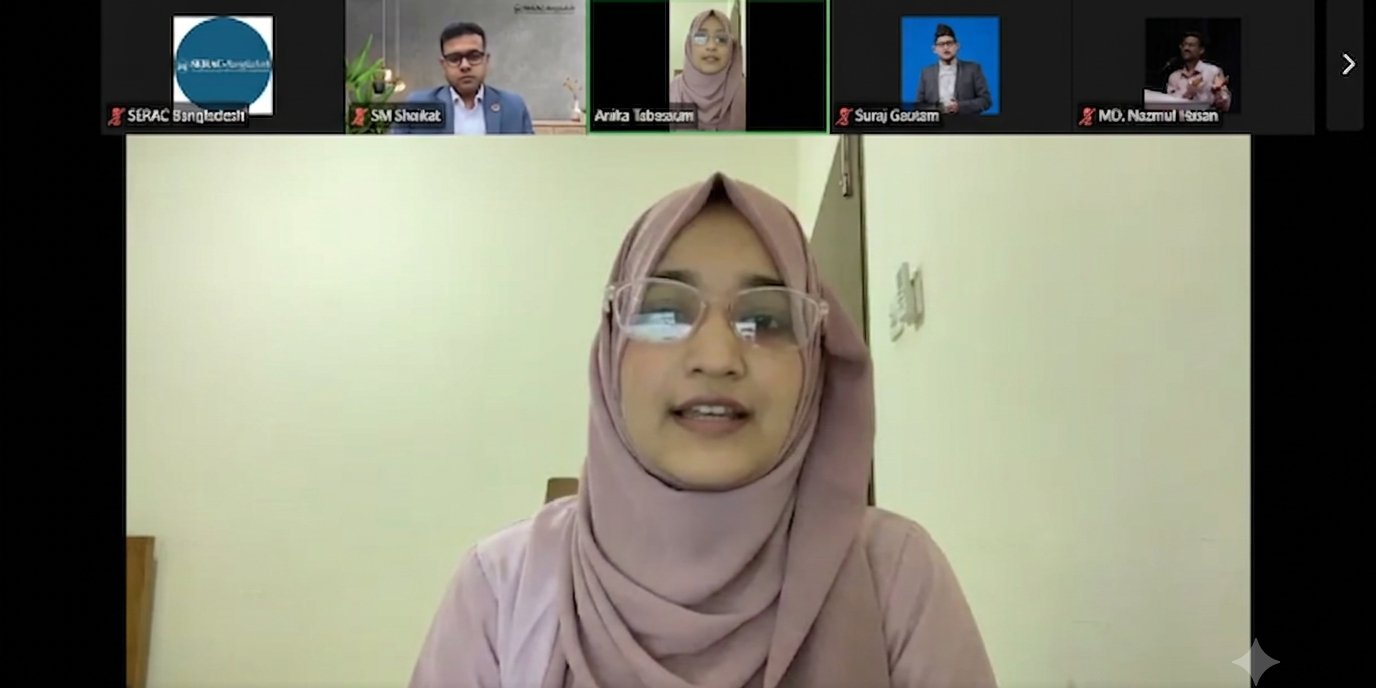
On 9 July 2026, SERAC-Bangladesh successfully organized the official High-Level Political Forum on Sustainable Development (HLPF) 2026 Virtual Side Event, titled “Youth, Climate, and Careers: Adapting Aspirations in a Changing World.” The event convened youth leaders, researchers, policymakers, and development practitioners from across South Asia to discuss how climate change is reshaping young people’s aspirations, livelihoods, and career pathways.
The session was moderated by Anika Tabassum, Program Development Associate at SERAC-Bangladesh, and featured an esteemed panel comprising SM Shaikat, Executive Director of SERAC-Bangladesh; Fsahat Ul Hassan, Founder and CEO of Youth Advocacy Network (YAN), Pakistan, and Vice President (Asia Group) of the Islamic Cooperation Youth Forum (ICYF); Sonika Poudel, PhD Researcher at Virginia Tech (USA); Amrit Devkota, Founder and Director of IDEAS International and Founder and Chief Advisor of the Nepal Youth Network on Sustainable Development (NYNSD); and Er. Suraj Gautam, Researcher in Disaster Risk Management and Geo-Hazards, Nepal. Together, they explored the need for green jobs, youth leadership, climate resilience, and regional cooperation to achieve sustainable development.
Climate Change is Reshaping Youth Aspirations
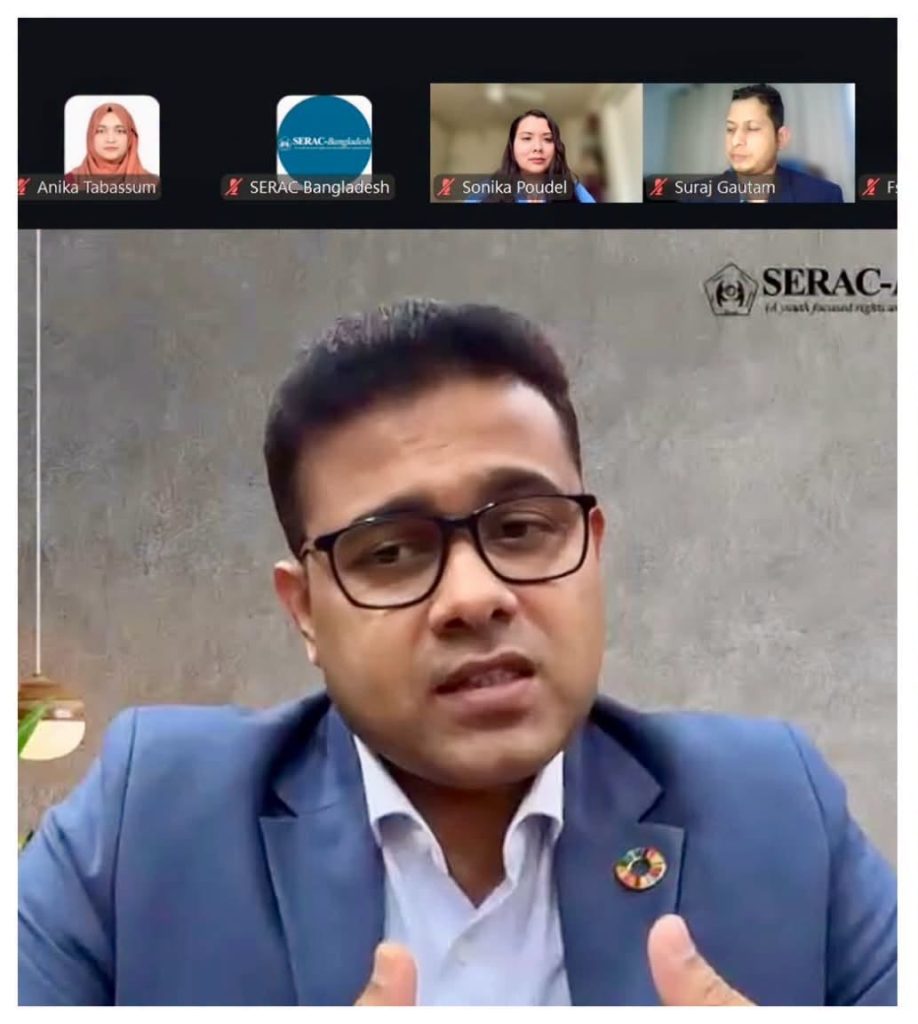
Opening the discussion, SM Shaikat, emphasized that “Climate change is no longer just an environmental concern. It is reshaping our economies, our cities, our education systems, our labour systems, and the aspirations of an entire generation.”
He noted that floods, cyclones, heatwaves, and environmental crises are changing not only landscapes but also the futures of millions of young people by influencing where they can live, the careers they can pursue, and the opportunities available to them. Highlighting the importance of youth leadership, he stated:
“Young people are not only demanding change- they are already creating it. The question is whether our institutions, policies, and investments are capable of recognizing, supporting, and scaling their leadership.”
He further emphasized that young people in Bangladesh seek meaningful careers that contribute to healthier communities, resilient cities, stronger democracies, and a sustainable planet.
Climate Change and Career Pathways
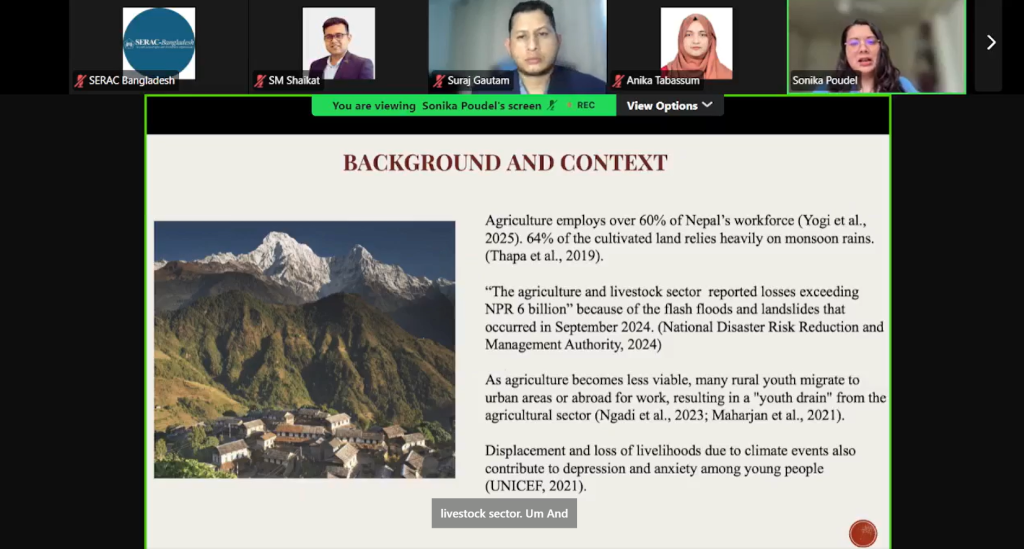
Sonika Poudel, presented findings from her research titled “Impact of Climate Change on Career Pathway Choices of Youth in Nepal.”
Her research highlighted that agriculture employs more than 60% of Nepal’s workforce, yet increasing climate variability- including erratic rainfall, floods, droughts, and landslides, is making agricultural livelihoods increasingly uncertain. As a result, many rural youth are migrating to urban centres or abroad, while others are reconsidering careers in agriculture.
The study also found growing interest among young people in climate adaptation, agricultural innovation, research, and sustainable development. To prepare youth for these emerging opportunities, she recommended strengthening practical agricultural education, expanding internships and innovation labs, supporting student agripreneurship, increasing applied agricultural research, and integrating mental health support into climate adaptation programmes.
Amrit Devkota, highlighted the gap between youth policies and their implementation. He stressed that many young people lack exposure to opportunities despite the existence of supportive policies. He called for greater investment in skill-based education, stronger university-industry partnerships, better implementation of youth policies, and improved access to leadership platforms and employment opportunities.

Regional Collaboration and Youth Leadership

Fsahat Ul Hassan, underscored the importance of regional cooperation and youth diplomacy in advancing youth participation and sustainable development across South Asia.
Er. Suraj Gautam, shared practical examples of how citizen science, participatory mapping, frontier technologies, and low-cost early warning systems are helping vulnerable communities in the Nepal Himalayas strengthen disaster resilience.
Looking Ahead
The discussion reinforced that climate change is reshaping not only the environment but also education, employment, and future career pathways. Addressing these challenges requires meaningful youth participation, investments in green skills, innovation, and stronger collaboration among governments, educational institutions, and development partners.
By organizing this official HLPF 2026 side event, SERAC-Bangladesh reaffirmed its commitment to promoting youth leadership, climate action, democratic participation, and sustainable development. The event concluded with a shared message: empowering young people with the skills, opportunities, and platforms to lead is essential for building resilient communities and achieving the Sustainable Development Goals.