
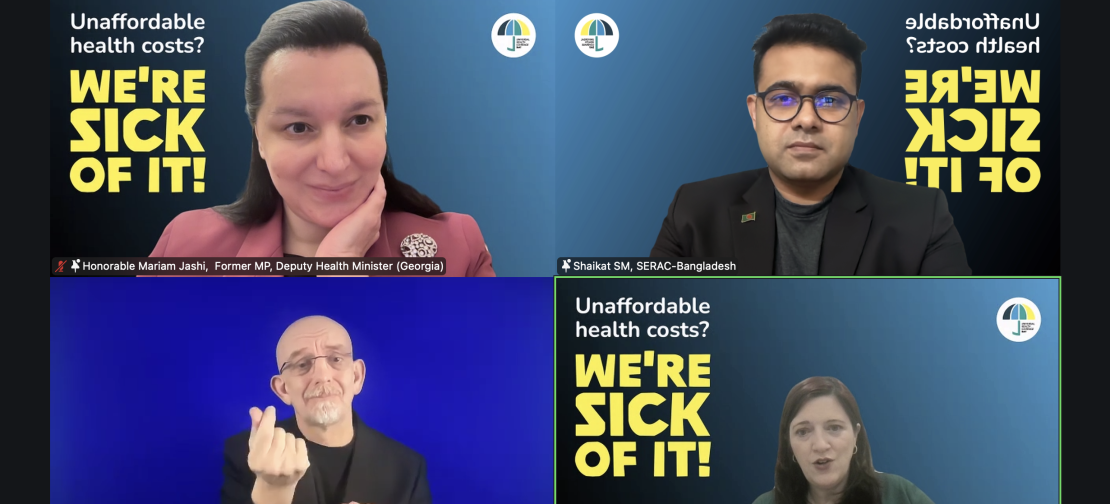
On 12 December 2025, SM Shaikat, Executive Director of SERAC-Bangladesh and a member of the UHC2030 Civil Society Engagement Mechanism (CSEM) Advisory Group, spoke at the UHC Day 2025 Annual Town Hall, a global virtual dialogue convening youth advocates, parliamentarians, civil society organizations, and international partners.
Organized under the UHC Day 2025 theme, “Unaffordable Health Costs? We’re Sick of It!”, the Town Hall provided a platform for open exchange on how to accelerate progress toward Universal Health Coverage (UHC), with a strong focus on financial protection and people-centred health systems. The event was co-hosted by UHC2030, CSEM, WHO Youth Council, IFMSA, IPSF, IAPO, ICN Alliance of Student and Early Career Nurses, and the UN Major Group of Children and Youth.
Bringing ground realities from Bangladesh and the Global South
During the youth–parliamentarian dialogue, Shaikat shared ground-level experiences from Bangladesh, highlighting that out-of-pocket expenditure accounts for around 67-68 percent of total health spending, pushing an estimated five million people into poverty each year due to health costs. Drawing from SERAC’s work with urban poor and climate-vulnerable communities, he emphasized how young people often delay or forgo care for injuries, reproductive health, mental health, and non-communicable diseases because essential costs remain unaffordable.
He also reflected on a wider Global South pattern where serious illness frequently leads to private fundraising, underscoring the absence of effective financial risk protection in many health systems. He noted that without strong financial protection, Universal Health Coverage remains inaccessible for those who need it most.
Emphasizing accountability, budgets, and participation
In his intervention, Shaikat underscored the importance of increased and accountable public health budgeting to strengthen financial protection, advance health security, and address long-neglected and underserved health issues. He highlighted that financing reforms must be accompanied by meaningful youth and civil society participation, in line with recent World Health Assembly resolutions on social participation and health financing.
As a member of the UHC2030 CSEM Advisory Group, he emphasized the role of civil society in bridging policy commitments with lived realities, ensuring that health financing decisions reflect the needs of marginalized communities.
A collective call to action
The Town Hall concluded with a shared call for governments and global leaders to translate commitments made at the UN High-Level Meeting on UHC and the World Health Assembly into concrete reforms ahead of the 2027 UN High-Level Meeting on UHC. Participants highlighted the importance of protecting health budgets, reducing out-of-pocket payments, and institutionalizing social participation mechanisms.
SERAC-Bangladesh reaffirms its commitment to advancing youth-led advocacy, accountable public health budgeting, and rights-based health systems that protect people from financial hardship. Through national and global platforms, SERAC will continue to contribute to shaping health systems that are accessible, affordable, and equitable for all.