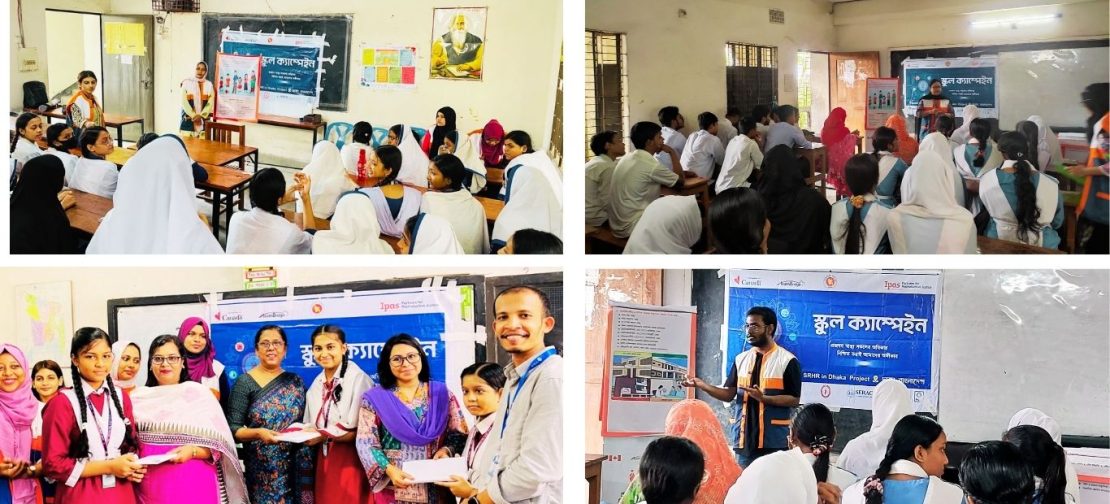
In July 2025, SERAC-Bangladesh, under the Improving SRHR in Dhaka Project, supported by Ipas-Bangladesh funded by Global Affairs Canada through the HealthBridge Foundation of Canada, conducted a series of impactful school campaigns for the dissemination of Sexual and Reproductive Health (SRH) knowledge across Dhaka city. Spanning multiple areas including Kazi Alauddin Road, Churiharra, Bongshal, Meradiya Khilgaon, Chonpara Demra, Vatara Badda, Ahmedbag Bashabo, Hazaribag, Nandipara Madartek, Gabtoli, Duaripara Pollobi, Mirpur, Dholpur, Jatrabari, Uttar Badda, Mohakhali, Bosila Mohammadpur, Paries Road, and Uttara Sector-11, the campaign reached a total of 897 participants directly, creating a strong ripple effect in the community.
The initiative brought together a wide range of participants, including 738 girls and 159 boys. Among them, 575 were aged 19 years, comprising 495 girls and 80 boys, while 322 participants were 20 years and older, including 243 women and 79 men. Teachers, community members, general practitioners and volunteers played an active role, alongside the large number of secondary-level students who formed the majority. Educators numbered 142, general practitioners 12, volunteers 175, and community members 568, reflecting the inclusive approach of the campaign.
The sessions covered adolescent health, menstrual health, and service accessibility, along with discussions on sexual and gender-based violence and the promotion of OGSB call center and social media platforms. The program aimed to raise awareness through interactive discussions and knowledge-sharing, concluding with quiz competitions to reinforce learning and maintain student engagement. These campaigns provided students with accurate, stigma-free information, addressing critical gaps in adolescent sexual and reproductive health education in Bangladesh, where taboos, early marriage, gender-based violence, and unsafe MR remain persistent issues.
Such initiatives are vital for Bangladesh as they offer young people the tools to make informed decisions about their health, break down long-standing cultural barriers, and ensure access to essential services. To sustain the impact, these campaigns need to be integrated into continuous, school-based programs. This can be achieved by training teachers as SRH resource persons, highly incorporating SRH education into the national curriculum, partnering with local health facilities for ongoing awareness activities, and fostering peer-led initiatives to create a supportive learning environment. Digital platforms can also be leveraged to provide ongoing access to information.
By ensuring continuity and institutional support, school-based SRH awareness campaigns have the potential to transform the lives of young people across Bangladesh, fostering a healthier, more informed, and empowered generation that can lead the nation towards a future where knowledge, equality, and health are priorities for all.