
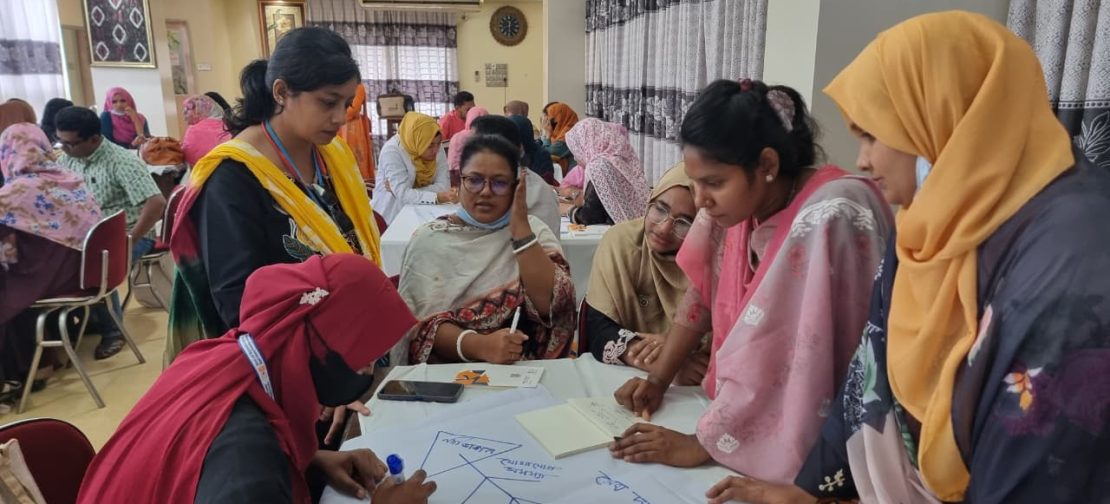
 As part of the Youth Catalyst initiative by UNFPA Bangladesh, with support from Sida, SERAC-Bangladesh successfully organized a district-level workshop in Noakhali titled “Integrating SRHR and Climate Resilience into Routine Health Services to Enhance Service Delivery and Sustainability.”
 The workshop brought together 30 frontline healthcare providers, including midwives, SACMOs, FWVs, and FPIs from various health facilities across Noakhali. The goal was to strengthen participants’ understanding of how climate change impacts sexual and reproductive health and rights (SRHR) and family planning services, and to build their capacity for ensuring continued, quality care in climate-vulnerable settings.
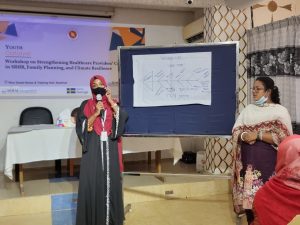
Throughout the day, participants took part in interactive sessions, group mapping, and solution design exercises to identify challenges in service delivery and design practical, climate-resilient adaptations that can be implemented at the facility level. Using structured worksheets, each group presented their insights and recommendations, fostering shared learning and collaboration among service providers.
 The event was chaired by Mr. Mahmudul Hasan, Assistant Director, Family Planning Office–Noakhali, and honored by the presence of Dr. Mariam Sheme, Civil Surgeon–Noakhali, as Chief Guest, and Dr. Sadia Samrin Hridi, Field Officer (M&E), UNFPA Bangladesh, as Special Guest. The workshop also featured an engaging technical session by Dr. Shohel Khan, Associate Professor, Department of Environmental Science and Disaster Management, Noakhali Science and Technology University, who discussed the intersection of environmental change and public health systems.
The sessions were facilitated by Md. Nazmul Hasan, Innovation and Youth Specialist, SERAC-Bangladesh, with support from Kakoli Akter, SBCC Officer; Md. Najmul Islam, Finance Associate; and Sapna Rani Mondol, Intern.
 This workshop in Noakhali follows similar initiatives in other climate-vulnerable districts and reflects SERAC-Bangladesh’s continued effort to build climate-resilient health systems and empower local service providers to adapt SRHR and family planning services amid increasing climate challenges.