
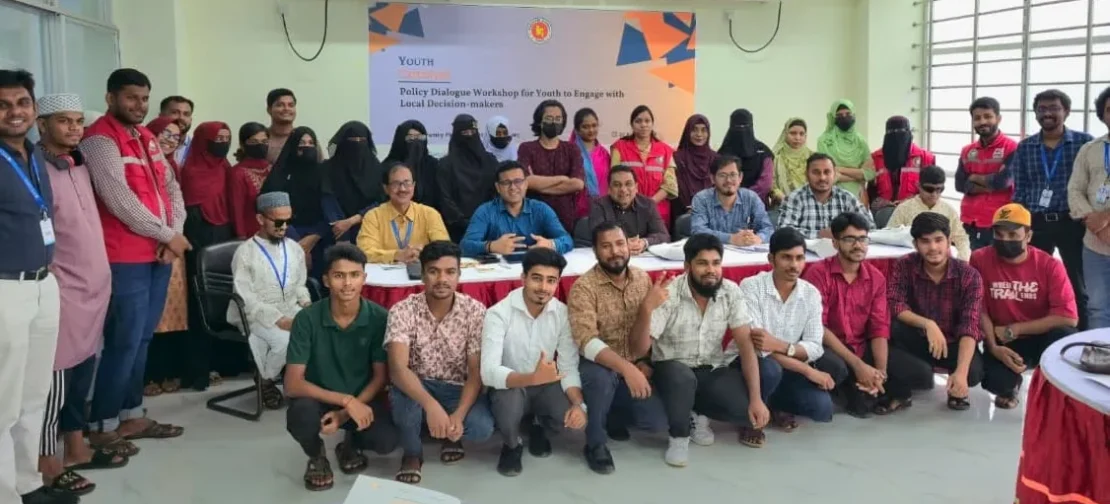
Sunamganj, 7 August 2025 – SERAC-Bangladesh hosted a day-long workshop titled “Policy Dialogue Workshop for Youth to Engage with Local Decision-makers”—as part of the Youth Catalyst initiative of UNFPA Bangladesh, funded by the Swedish International Development Cooperation Agency (Sida), and implemented by SERAC-Bangladesh held at the District Family Planning Office in Sunamganj.
 The event brought together thirty youth representatives from diverse backgrounds, including marginalized and climate-vulnerable communities, to engage directly with local decision-makers from the Department of Family Planning (DGFP), the Ministry of Women and Children Affairs (MoWCA), and the Department of Environment. The dialogue provided a platform to discuss barriers to youth-centered, climate-resilient sexual and reproductive health and rights (SRHR) services, especially in the haor region where recurring floods severely disrupt access to essential care.
 In his opening remarks, SM Shaikat, Executive Director of SERAC-Bangladesh, highlighted the urgency of addressing the compounded impacts of flooding on health access. He noted that many adolescents are unaware of adolescent-friendly health centers or the services they provide. Equitable change in the health and family welfare sector must begin with ensuring accessibility for young people-particularly now, when the youth population in Bangladesh is at its peak.
Presiding over the session, Md. Niazur Rahman, Deputy Director, Department of Family Planning (DGFP), Sunamganj, emphasized the importance of grounding policies in local realities. He acknowledged that while policies exist, multiple challenges in implementation persist. For the haor region, he said, health, education, and communication must be prioritized, with planning that reflects the distinct needs of both the monsoon and dry seasons.
Adding to the discussion, Md. Mohaiminul Haque, Assistant Director at the Department of Environment, underlined that Sunamganj is among Bangladesh’s most climate-vulnerable districts, where flooding and waterlogging contribute to higher school dropout rates and increased child marriage.
Facilitating the workshop, Md. Salim Mia, Deputy Director (Program) at SERAC-Bangladesh, reiterated the organization’s commitment to amplifying youth voices and ensuring that their recommendations are incorporated into the national white paper on climate-resilient SRHR services.
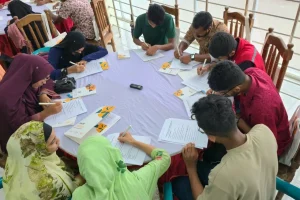
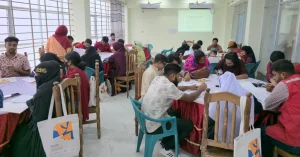 The workshop featured interactive group discussions led by Nazmul Hasan (Innovation and Youth Specialist), with support from Mizanur Rahman Akond (Advocacy Specialist) and Ruhiyat Tasnim (MEL Officer). Youth participants shared their lived experiences, identified service gaps, and co-developed actionable policy recommendations in collaboration with stakeholders. This dialogue marks an important step toward bridging the gap between communities and policymakers, ensuring that SRHR services in Bangladesh are inclusive, accessible, and resilient in the face of climate change—especially for those most at risk.